
At an event, image rights almost always come up too late: when it is time to publish the photos, once the guests have gone home and nobody is in a position to sign anything. Handled beforehand it takes a few minutes. Handled afterwards it gets expensive.
This guide covers what image rights actually protect, when a release is needed, what the document has to contain to be worth anything, and how to react to a takedown request. It describes the French regime, one of the most protective in Europe, and flags where other countries differ. It is not legal advice: for an event with real exposure, have your documents reviewed by a lawyer.
What image rights protect
Image rights have no dedicated article in French law. They flow from article 9 of the Civil Code, which states that everyone has the right to respect for their private life, and they were built by the courts decision after decision. Most European countries have an equivalent, grounded either in personality rights or in their own civil code, with real differences in how strict they are. Germany has a specific statute on the publication of portraits; the United Kingdom has no general image right and relies on privacy and data protection instead.
The principle fits in one sentence: any identifiable person holds a right over the use of their image and can object to it being published. Three words in that sentence carry the weight.
- Identifiable. Someone shot from behind, blurred, too far away or masked is not concerned. The test is not the face but whether recognition is possible; a distinctive silhouette or a visible tattoo is sometimes enough.
- Use. The right bears mainly on publication, not on taking the picture. Photographing your guests and keeping the photos to yourself raises no issue. Publishing them does.
- Object. This is a right to object, exercisable at any time, including after a release has been given.
The right belongs to the person themselves. It does not pass to heirs as such, and it cannot be assigned in a general and definitive way, which is exactly why over-broad releases hold up badly.
When a release is needed
The answer turns on two things: the person's role in the image, and what you intend to do with it.
When it is not
The person is not identifiable. Shot from behind, backlit, out of focus.
The photo is a wide shot. A dance floor, a conference room, a cocktail seen from a distance. As long as no one person is the subject of the image, individual agreement is not required. The tipping point comes when you crop to one person or a small group, who then become the subject.
You are not publishing. Keeping the photos in a private gallery, reachable only by participants through a link or a QR code, stays close to the private circle. Posting to a public account, a website or a brochure leaves it.
When it is
As soon as an identifiable person is the subject of the photo and that photo leaves the private circle. A guest's portrait posted on the company account, a participant's picture used in a sales brochure, a child's photo put on a charity's website.
One misconception is worth killing straight away: a public place is not a release. It permits the shot, not the publication. A person photographed alone and recognisable in the street keeps their right to object.
The four event situations that cause trouble
Weddings
The couple usually signs a contract with the photographer that includes a licence for their portfolio. The guests signed nothing. Guest photos published on the photographer's website or on the venue's social accounts leave the private circle and need those guests' agreement.
In practice the fix is one sentence on the invitation or on a sign at the entrance, saying a gallery is open and that photos may be used by the photographer, with a contact address to object. The gallery shared between guests stays inside the private circle as long as it is not public.
Company offsites
This is the most tightly framed case, because the employment relationship weakens consent. Three rules.
A general clause in the employment contract is not enough. You need a specific agreement covering that event and those media. The agreement has to be freely given, which means a refusal cannot bring a sanction, a remark, or exclusion from a group photo presented as compulsory. And it stays revocable: an employee who changes their mind, or who leaves the company, can ask for removal.
This overlaps with how long you keep the files, covered in the guide to event photo retention periods.
Children
The release is given by both holders of parental authority, not by the child, and not by one parent alone. Collect it in writing before the event, usually with the registration form, separating the uses: group photo displayed on the premises, publication on the website, use in external communication.
One point often missed: once they reach adulthood, the child can ask for photos taken during their minority to be removed. That is why an open-ended duration fits this case particularly badly.
Conferences open to the public
Several statuses coexist in the same room. Speakers generally sign a licence in their agreement. Attendees do not. A sign at the entrance saying the event is being photographed, with a contact point to object, is the common practice, but it is not a release for an individual portrait republished in marketing.
Provide a visible way to opt out, a differently coloured badge for instance, and brief the photo team before the doors open.
The release template to copy
A release is worth what its precision is worth. Four elements make it solid: media, duration, territory and purpose. Wording such as all media, worldwide, in perpetuity is regularly set aside by courts, on the grounds that the person could not judge what they were agreeing to.
Here is a template usable as it stands for an event, to adapt to your situation.
Authorisation to capture and publish my image
I the undersigned (first name, surname), residing at (address), authorise (name of the organiser or company) to photograph and film me at (event name), held on (date) at (location).
I authorise publication of these images on the following media: (list precisely, for example: online gallery restricted to participants, the organiser's website, the organiser's social media accounts, internal printed material).
This authorisation is granted for a period of (for example: three years) from the date of the event, for the following territory: (for example: France and the European Union), and for the following purpose: (for example: institutional communication and event write-up).
The images will not be exploited commercially nor transferred to any third party beyond what is stated above.
I may withdraw this authorisation at any time by written request to (contact email address). Withdrawal ends publication going forward, within a reasonable delay, without affecting material already printed or distributed.
Signed at (place), on (date). Signature.
For a minor, replace the first sentence with the wording below and have both parents sign.
We the undersigned (first names, surnames), acting as holders of parental authority over the child (first name, surname), born on (date), authorise (name of the organiser) to photograph and film our child at (event name).
Keep signed releases for as long as you publish the images, and no longer. A tracking sheet linking each release to the event it covers saves you searching a mailbox three years later.
What changes when the photos come from guests
At a modern event, a good share of the photos is not taken by the photographer but by the participants, who drop them into a shared gallery. That shifts three things.
Who is answerable. The guest who took the photo is its author. The organiser who provides the gallery and decides what becomes of it is the one people will come to if there is a complaint. So the organiser is the one who has to plan the prior notice and the takedown channel.
What the gallery allows. A closed gallery, entered through a QR code or a private link, keeps the photos within the circle of participants. The shared photo gallery guide sets out the settings that decide where that boundary sits, downloads in particular.
The republishing reflex. The real risk is not the gallery, it is the social media manager who pulls three photos out of it for the company account the following Monday. That is when a release becomes necessary, and that is exactly when nobody thinks about it. The agency side of this is covered in post-event photo reporting.
Handling a takedown request
A takedown request is handled by granting it. The person does not have to explain themselves, and arguing to keep one photo out of eight hundred exposes you to a dispute with nothing on the other side of the scale.
Three things prepare for that moment before it arrives.
- Name a recipient. One email address, shown on the notice and in the gallery, rather than a request made in passing to an organiser who will not pass it on.
- Set a delay. A few working days is enough to be in good faith. Silence is what turns a polite request into a formal notice.
- Check your tool can do it. Deleting one specific photo has to be possible without starting the gallery over, and the deletion has to apply to the displayed copies, not only to the original file.
If the photo was published elsewhere, on a social network or in a brochure, removal applies going forward. Copies already printed and distributed are not recalled, which the template above states explicitly.
Image rights and the GDPR are two different regimes
Both apply in parallel and they do not cover the same ground.
Image rights come from civil law and protect the use of an identifiable person's likeness. The GDPR is a European regulation on the processing of personal data, which a photo becomes as soon as it allows someone to be identified. A photo can be covered by a signed release and still breach the GDPR, for instance if no retention period was ever set. The reverse holds too.
One useful detail when a gallery offers to find your photos by selfie: that feature relies on biometric processing, which falls under the GDPR and requires explicit consent, separate from the publication release. Here is what a compliant collection looks like, captured on our demo event.
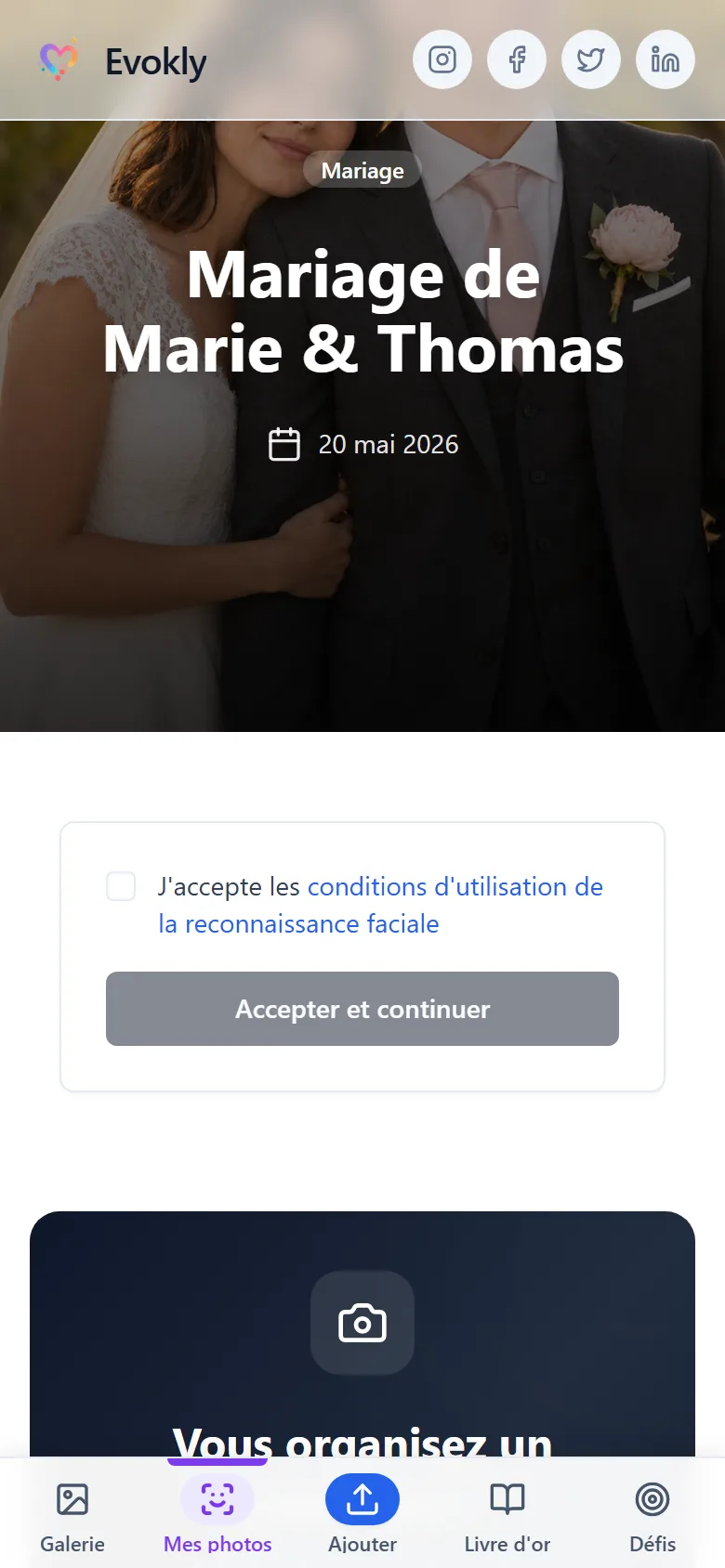
Applicable durations and the documentation to produce are in the GDPR guide to retention periods. The specific case of facial recognition is covered for professionals in the article on facial recognition and the GDPR for photographers.
What you are exposed to
The most common route is civil: the person asks for removal and, where relevant, damages. Awards for a non-commercial publication by a private individual stay moderate, but the legal costs and the time spent go well past the value of the photo.
A criminal route exists for the most serious situations. Article 226-1 of the French Criminal Code punishes capturing the image of a person in a private place without their consent by one year of imprisonment and a 45,000 euro fine. Article 226-2 covers keeping and circulating those images. These provisions are about invasion of privacy, not about a badly framed group shot at an offsite.
For an organiser, the real risk is less legal than relational: an employee or a guest who discovers their portrait in a commercial publication without ever having been told. A sentence of notice beforehand and a clear takedown channel head off nearly all of these.
FAQ
Do I need a release to photograph my guests?
To take the photo in a private setting and keep it, no. To publish it, yes, as soon as the person is identifiable and is the subject of the image. Image rights bear on publication more than on the act of shooting. A closed gallery reachable only by guests through a private link stays close to the private circle; a post on social media or a public website leaves it.
Can a photo taken in a public place be published freely?
No, and this is the most widespread misconception. A public place allows you to take the picture, not to publish it. If an identifiable person is isolated and is the subject of the image, their agreement is still required. A wide shot where nobody is the main subject, a dance floor or a conference room for instance, needs no individual release.
What has to be in a photo release?
Four elements, without which it is fragile: the media it covers, the duration, the territory and the purpose. Wording such as all media, worldwide, in perpetuity is regularly set aside by courts because it does not let the person judge what they are agreeing to. Add the identity of both parties, the date and the ability to withdraw.
How do image rights work for children?
The release has to be given by both holders of parental authority, not by the child and not by one parent alone. Collect it in writing before the event, usually with the registration form. A child who reaches adulthood can ask for photos taken during their minority to be removed, which makes an unlimited duration particularly risky in this case.
Can an employer publish photos from a company offsite?
Only with a specific agreement, not a general clause buried in the employment contract. That agreement has to be freely given, which means a refusal cannot lead to any sanction or disadvantage. An employee who agreed can change their mind later, and the company then has to pull the photos from the media concerned.
Are image rights and the GDPR the same thing?
No, they are two distinct regimes that apply at the same time. Image rights come from national civil law and protect the use of an identifiable person's likeness. The GDPR is a European regulation on the processing of personal data, which photos are part of. A photo can be covered by a signed release and still breach the GDPR, for instance if no retention period was set.
What should I do if a guest asks for a photo to be removed?
Remove it, without asking for a reason. The person does not have to justify the request, and arguing exposes you to a dispute for no gain. Decide before the event who receives these requests and within what delay you handle them, and pick a tool that lets you delete one specific photo rather than starting the gallery over.
In short
Image rights are decided at publication, not at the shutter. As long as the photos stay among the participants of an event, in a closed gallery, the question barely arises. It arises when you publish, and that is when you need a release that is precise on four points: media, duration, territory, purpose.
The rest is organisation: give notice before the event, name a contact address, and remove without arguing when someone asks.
Create a private gallery for free and keep your event photos among the people who were there.