
The day after a wedding, the photos are everywhere except in one place. The photographer will deliver theirs in a few weeks. The guests' photos, often the funniest and most spontaneous, sit in 80 phones and will never come out without a shared album set up in advance.
A shared wedding photo album is that single place where every guest drops their photos and sees everyone else's. Seven options let you create one, free or paid, with or without an app. This comparison reviews them on the criteria that really make a difference on the day, without overselling any of them.
What a shared wedding album has to do
Before comparing, it helps to know what you expect from the album. Four criteria decide everything.
Ask nothing of the guests. Every extra step, installing an app, creating an account, finding a password, loses part of the table. At a wedding, guests are anywhere from 7 to 87 years old. The tool has to work for both ends.
Keep the original quality. A photo from a recent phone is 12 megapixels. A tool that compresses it to 2 megapixels makes it useless for a print or a photo book.
Get real participation. What counts is not the number of features but the number of guests who actually drop their photos. A perfect tool used by 30% of guests brings back less than a simple one used by 80%.
Let you get everything back. At the end, you want one complete folder, in original quality, without saving 600 photos one by one.
The comparison table
| Option | Free | App to install | Original quality | Expected participation | Getting photos back |
|---|---|---|---|---|---|
| WhatsApp group | Yes | Already installed | No | Medium, then collapses | One photo at a time |
| Google Photos album | Yes | Google account | Depends on setting | Medium | Bulk, albums mixed |
| Shared iCloud album | Yes | Apple only to contribute | Yes | Low outside iPhone | Bulk |
| Drive or WeTransfer | Yes | No, but sometimes a sign-in | Yes | Low | Raw folder |
| Wedding app (Wedbox, WedShoots) | WedShoots yes, Wedbox freemium | Yes | Depends on plan | 30 to 60% | Varies |
| Photographer's gallery | Included in the package | No | Yes | Not applicable | Complete, but the pro's photos only |
| QR code web gallery (Evokly) | Up to 100 photos, then €69 | No | Yes | 70% and above if the code is visible | Complete, one file |
The participation figures are orders of magnitude observed at weddings of 80 to 150 guests, with an announcement made on the mic. Without the announcement, every option drops.
The seven options in detail
1. The WhatsApp group
It is the reflex, and it works for the first few hours. Then three things happen. The photos are compressed, so unusable for prints. Guests who dislike notifications leave or mute the group. And you end up saving photos one by one between "thank you for a lovely day" messages. The article on sharing wedding photos without WhatsApp or Drive goes through these three limits.
Keep it for very small weddings, or as a backup for the day after.
2. The shared Google Photos album
Free, effectively unlimited, and quality can stay good if every contributor left the "original quality" setting on. The problem is the entrance: adding photos requires a Google account. Some of your guests don't have one, or don't have it on their phone, and give up at the sign-in screen. The comparison Google Photos vs event gallery digs into this.
A good choice if your circle is overwhelmingly on Android with an active Google account.
3. The shared iCloud album
Google Photos' mirror on the Apple side. Smooth, original quality, built into the Photos app everyone already has. But an Android guest can only view the album through a public link, not contribute to it. At a wedding, half the phones in the room are therefore left out.
A good choice for a family circle that is 100% iPhone, and only then.
4. The Google Drive folder or WeTransfer link
Here quality is preserved and there is no album to join. In exchange, there is no album at all: guests drop files into a folder without seeing anyone else's, without the pleasure of discovering the evening through other eyes. The experience is administrative, participation suffers, and you get back a folder of 400 loose files with duplicates. Upload links also expire, usually between 7 and 30 days.
Useful for collecting photos from one relative who shot a lot, not as a collective album.
5. The dedicated wedding app
Wedbox and WedShoots are built for this, with a shared photo feed, sometimes a live slideshow, and an interface designed for couples. Their limit comes down to one word: installation. Every guest has to download the app, create a profile and join the album with a code. Some guests won't, especially older ones and those whose phone is full. Expect 30 to 60% participation at best. The comparison Wedbox, WedShoots or web gallery goes into detail on both apps.
A good choice for a small wedding whose guests are warned in advance and comfortable with apps.
6. The photographer's delivery gallery
Your photographer will deliver their photos in an online gallery, often beautiful, sometimes password-protected with a print shop. It is an excellent tool, but it answers a different question: it distributes the professional's work, it does not collect the guests' photos. The two complement each other. The photographer's gallery for the official images, a shared album for everything they didn't see.
7. The QR code web gallery
The last approach removes the installation. The wedding gallery is a website. Guests scan a QR code on the table with their phone camera, the gallery opens in the browser, they tap "Share a photo" and pick their files. Fifteen seconds, no account, and the same gesture for a 20-year-old or a 75-year-old guest.
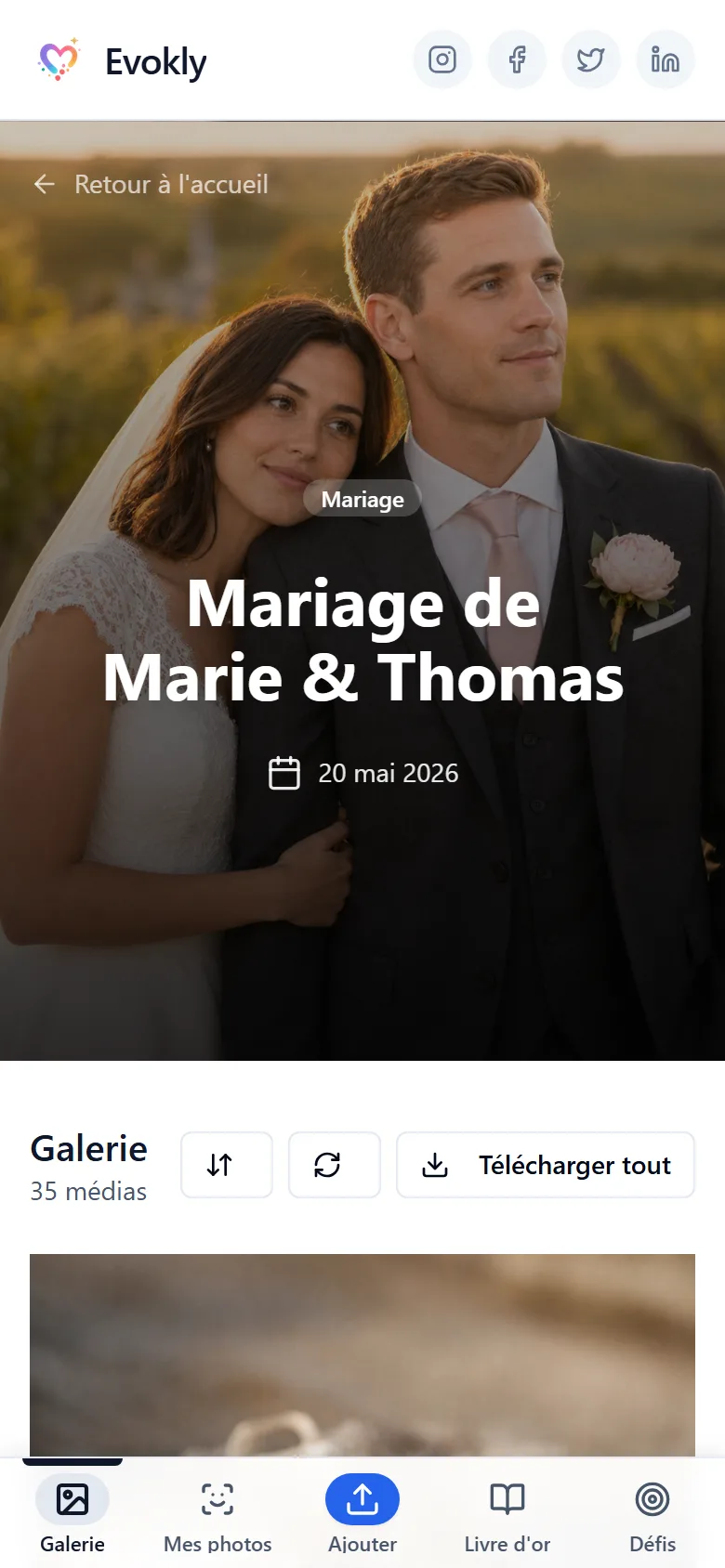
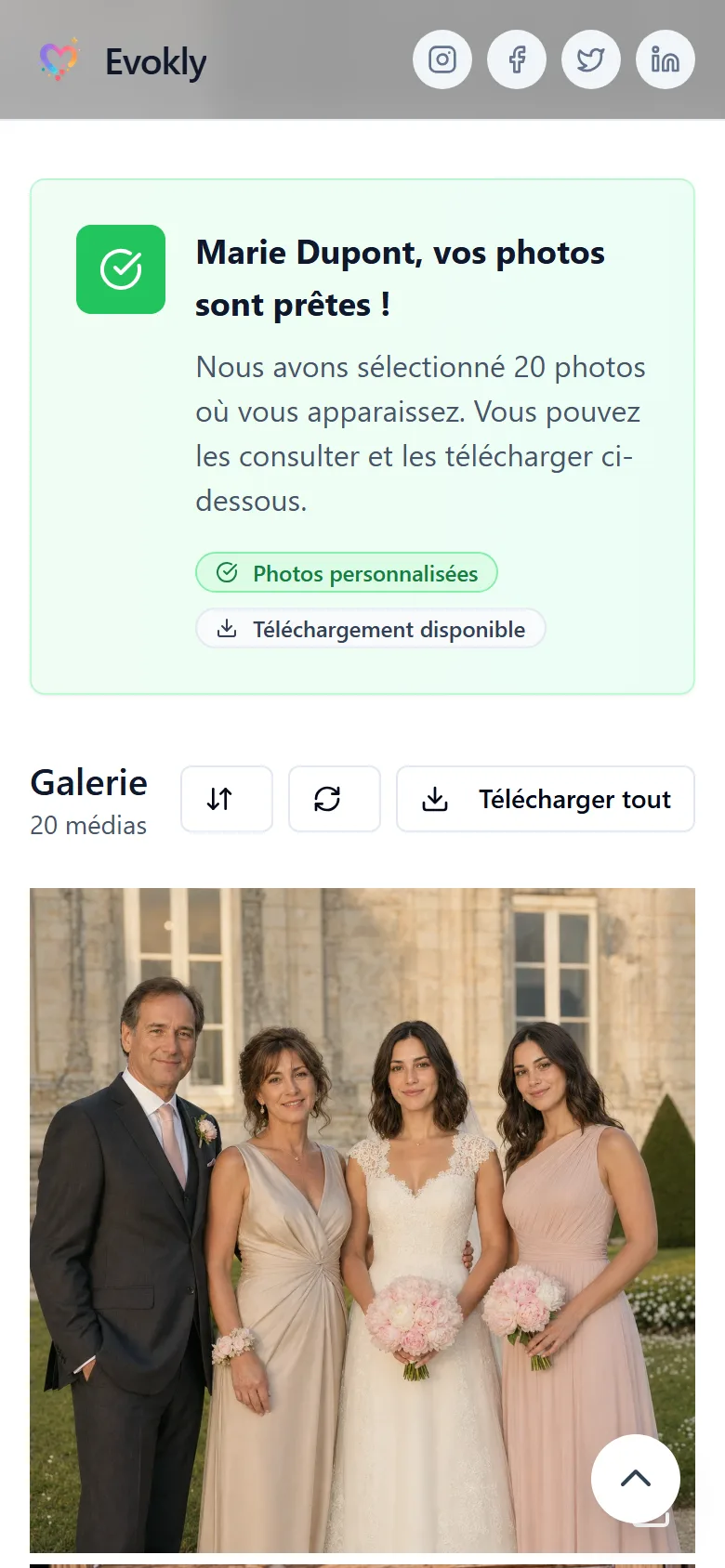
That is how Evokly for weddings works. Photos are kept in original quality, hosted in the European Union, and the organiser gets the whole gallery back in a single download. On the Event plan, facial recognition also lets each guest find the photos they appear in by taking a selfie, with their consent, instead of scrolling through 800 shots.
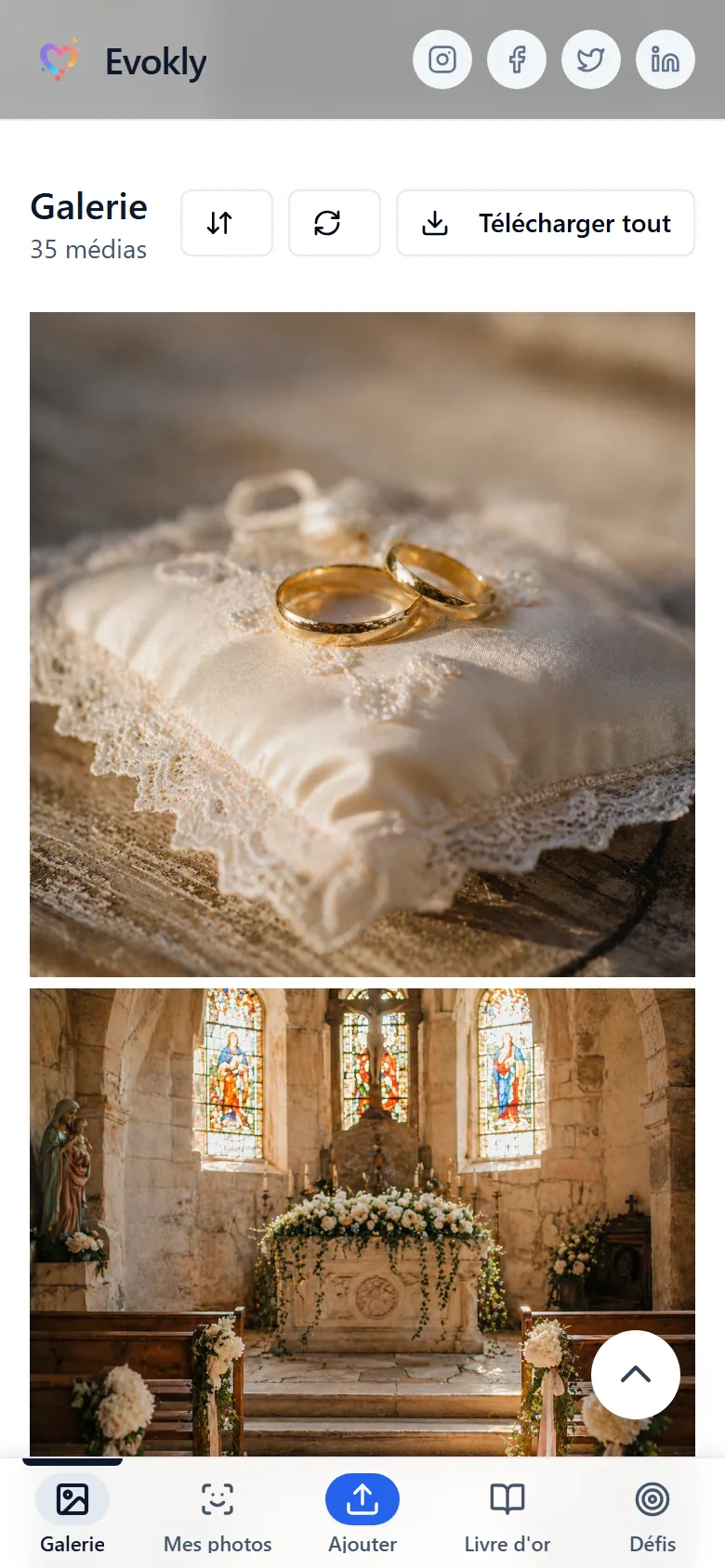
The trade-off is the QR code logistics: it has to be visible on the tables, at the bar and near the photo booth, and announced on the mic. The event QR code guide covers size and placement.
Which option for your wedding
Under 30 guests, a close and tech-comfortable circle. A shared iCloud or Google Photos album, created a week ahead, does the job very well. Just check everyone is on the same ecosystem.
30 to 80 guests. A dedicated app can work if you ask for the install in the invitation, but a QR code web gallery costs the same organising effort and loses nobody at the door.
80 guests or more, or mixed generations. The QR code web gallery is the only option that guarantees high participation. It is also the one that makes the day after simplest: one file to download, photos already separated from the chat.
In every case, the photographer's gallery remains your official album. The shared album sits alongside it, for the photos nobody else took.
Free or paid: what it really changes
Free is paid for elsewhere: in compression on WhatsApp, in the mandatory account on Google and Apple, in the install on WedShoots. None of these limits is a flaw in the tool, each was designed for something other than a wedding.
At Evokly, the free plan covers one event, 100 photos, 10 contributors and 15 days online. That is enough to test, or for a small civil ceremony. For a full wedding, the Event plan at 69 euros, paid once, lifts the photo and contributor limits, keeps the gallery for six months and adds facial recognition. Details are on the pricing page. Against a wedding budget, it is the price of one centrepiece, for every photo the photographer didn't take.
FAQ
What is the best shared photo album for a wedding?
The one your guests will actually use. For a wedding of 80 people or more with mixed ages, a web gallery reached through a QR code gets the best participation because it asks for no app and no account. For a small, tech-comfortable circle, a shared iCloud or Google Photos album is enough.
Is there a free wedding photo sharing site?
Yes, several. WedShoots is free but requires an app. Google Photos and iCloud are free but require an account to contribute. Evokly's free plan covers one event, 100 photos, 10 contributors and 15 days online, with no app and no credit card. Beyond that, the Event plan costs 69 euros as a one-off payment.
How do I share wedding photos without guests installing an app?
With a web gallery. Guests scan a QR code placed on the tables, the gallery opens in their phone's browser, and they add their photos in seconds. No install, no account. It is the only approach that loses nobody at the download step.
Do photos keep their quality in a shared album?
Not everywhere. WhatsApp compresses every image heavily. Google Photos may reduce quality depending on the sender's account setting. Dedicated galleries, iCloud and Drive keep the original files. If you plan a printed album, check this before choosing.
When should I create the shared album?
One to two weeks before the wedding, so you can test it from a phone other than your own and add the QR code or link to the menus, place cards or digital invitation. Keep it open at least two weeks afterwards: the best late-night photos often arrive a day or two later.
How do I get all the photos back at the end?
It depends on the tool. A WhatsApp group means saving photos one by one or exporting the chat. Google Photos and iCloud allow a bulk download but often mix albums together. A dedicated gallery offers one complete download in a single file, in original quality, with the photos already separated from everything else.
In short
A successful shared wedding album comes down to one thing: how many guests actually use it. Free consumer tools each leave part of the room out, through compression, a mandatory account or the ecosystem. Dedicated apps lose some guests at the install. The QR code web gallery asks nothing of anyone, provided the code is displayed and announced. Choose by the size of your wedding, create the album a week ahead, and leave it open for two weeks afterwards.